
Cyprus: Living Labs and Schools Growing Communities Together
Can you please tell us your name, your school, the age group of the children, and how many children participated in the visit?
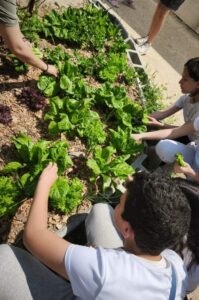
My name is Stalo Antoniou and I teach at the Apostolos Varnavas Primary School in Nicosia, Cyprus. Fifteen students, aged 8–9 years old, participate in the programme. As part of the project, we visit the urban garden at the Acropolis Park every two weeks for approximately 80 minutes each time.
How did the children react to the Living Lab visit? Was there a moment that particularly surprised you?
From the very beginning, the children viewed the visits as something exciting and different from their usual school routine. The outdoor setting, the freedom of movement, and the hands-on nature of the activities immediately captured their attention. During the first session, a few students found it difficult to stay focused, mostly because of their excitement and the novelty of the environment. However, this changed remarkably very quickly.
By the second visit, the children showed improved concentration, self-regulation, and respect for both the space and the programme’s routines. What stood out to me most was how naturally they adapted to working collaboratively. The available tools and working space were limited, meaning not all students could work at the same time. Despite this, there were no conflicts or frustrations. The children organised themselves independently by sharing and exchanging tools, taking turns, helping one another, and ensuring everyone had the opportunity to participate.
Many of the children were also fascinated simply by being in the space itself. For some of them, it was the first time they had ever seen a greenhouse, especially one of that size.
I was also deeply impressed by the response of children who often experience challenges in a traditional classroom setting. Students with autism, ADHD, emotional or learning difficulties, as well as a child with limited Greek language skills, were fully engaged and eager to contribute. The garden environment seemed to help many of them feel calm, capable, and included.
Another moment that stayed with me involved a child who had expressed intense fear of spiders during the first session and reacted very strongly when encountering insects. By the second visit, the reaction had become significantly milder, almost absent. It seemed that regular contact with nature and gradual exposure helped reduce fear and anxiety connected to the natural environment.
I was equally surprised by the children’s level of engagement throughout the entire 80-minute session. In a regular classroom lesson, some students usually ask to leave for the toilet or mention that they are tired. During the outdoor sessions in the garden, however, almost no one asked to leave, drink water, or rest, even on a warm day while standing and working outside. The children were completely absorbed in the activities and remained focused until the end.

What do you think the children learned from this experience that they could not learn in a classroom?
This experience allowed children to understand learning as something real, physical, and connected to everyday life. Instead of receiving information passively, they explored, experimented, cared for living things, and observed gradual change over time.
Many children mentioned during our reflection discussions that it had been a very long time since they had last touched soil with their hands. This simple observation was very meaningful and showed how disconnected many children have become from nature in their daily lives. The Living Lab gives them the opportunity to reconnect with natural materials, smells, textures, and living organisms in a direct and memorable way.
The children also developed a genuine interest in continuing these experiences beyond the programme itself. Several students asked to take plants home and were especially excited about using mycorrhiza in the soil at home after learning about its role in plant growth. Their curiosity extended beyond the activity itself and became something they wanted to apply in their own lives and families.
One especially memorable moment was when the children harvested and tasted lettuce from the garden themselves. All of them were eager to try it, including children who would normally avoid or complain about eating vegetables in other situations. Because they had planted and cared for the vegetables personally, they felt connected to the process and were excited to taste the result of their work.
In addition, the programme created opportunities for students to demonstrate abilities that are not always visible in traditional classroom lessons. Practical tasks, sensory experiences, movement, and teamwork allowed every child to participate successfully and confidently.
How do activities like urban gardening and Living Labs help children develop social skills such as collaboration, sharing, and care for others?
The activities encouraged cooperation in a very authentic and natural way. Since the tools and working areas needed to be shared, the children had to communicate, negotiate, wait patiently, and support each other continuously throughout the sessions. What impressed me was that this happened spontaneously, without adult intervention. They understood that everyone’s participation mattered and adjusted their behaviour accordingly.
During our reflection discussions after planting the vegetables, several children specifically mentioned cooperation as one of the most important things they had learned that day. They recognized that the activity could not succeed unless everyone worked together, shared responsibilities, and respected each other’s turn.
I also observed students helping classmates who needed encouragement or practical assistance, often without being asked to do so. The shared responsibility for the garden gradually created a stronger sense of teamwork and collective care.
At the same time, the children developed empathy not only towards one another, but also towards living organisms and the environment itself. Caring for plants, observing insects closely, and understanding natural processes encouraged a more respectful and less fearful relationship with nature.
In your opinion, how can initiatives like this contribute to building more inclusive and connected communities?
Initiatives like this create opportunities for children to experience inclusion and community through real participation rather than theory alone. In the Living Lab, every child was able to contribute in a meaningful way, regardless of academic level, language background, or individual difficulties.
The programme also encourages children to reconnect with nature and with shared public spaces in urban environments. This is particularly important today, as many children spend limited time outdoors or in direct contact with natural elements.
What I find especially valuable is that these experiences promote cooperation instead of competition. Children learn that shared spaces require care, respect, patience, and collective responsibility. In this way, projects such as FEED4FOOD help cultivate not only environmental awareness, but also more empathetic, inclusive, and socially connected future communities.